
Turkish manufacturing, made buyable end to end.
You've found the factory. The hard part is everything after: the spec, the sample approval, the capacity slot, the inspection, the customs file, the payment, the invoice, the certificate. SultanaExpress builds that chain as one platform — in the open, by the team that already built and ran this marketplace. Turkey first, Europe next.
- build plan
- 650-step build plan
- steps done
- 500 steps done
- automated quality gates
- 73 automated quality gates
- design system
- 106-element design system
As of 2026-10-07 — re-derived at every publish
Fig 1 — one order through the platform ↓One order. Three parties. Every rule enforced.
A simulation of the platform's built order flow: a mill in Bursa, a buyer in İstanbul or Europe, and SultanaExpress in the middle, holding the money and the rules.

Space pauses; [ and ] select the previous and next item; F follows it. While exploring, the arrow keys move the view and + / − zoom.
Fig 1 · Day 12 · SX-ORD-2026-000142
Drawing Fig 1
Simulated orders · invented companies · sample data
Simulated orders, invented companies and sample data. The rules shown are built and tested. Payments run in test mode: real money switches on after expert sign-off.
Fig 1, step by step
- Dawn. Uludağ Konfeksiyon, a verified supplier, is open for orders. Gemlik Örme's verification is still under review, so it stays out of buyer search.
- A buyer searches. Only published, verified suppliers come back: Uludağ Konfeksiyon and Nilüfer Tekstil, not Gemlik Örme.
- The buyer publishes a request for quotation, RFQ-2026-00142, and invites both mills.
- Both mills quote. The buyer accepts Uludağ Konfeksiyon's quote, and one step checks the price, the minimum order, the stock and a tentative capacity slot. The order is placed.
- Tech pack version 3 is pinned and shared with the mill, which may read it and propose changes. A payment intent is created.
- The buyer pays. The money goes into escrow, held by the platform, not to the mill, and the ledger posting balances.
- The mill confirms the order: the capacity slot is booked and a production plan is drafted. A pre-production (PP) sample is requested.
- The PP sample ships to the buyer. The mill tries to start bulk production and the platform refuses: 409, the PP sample is not approved.
- The buyer approves the sample. In the same step the plan starts, the order goes into production, and the operator sees both events.
- Material arrives; cutting and sewing begin. Sewing runs two days late, and the buyer's view shows the delay at once.
- The operator verifies the mill's GOTS certificate and records its expiry date.
- An independent inspector runs the final AQL inspection: 125 pieces from a lot of 2,400, with 0 critical, 3 major and 5 minor defects. The platform computes the verdict: pass.
- The goods leave the factory, the order ships and a shipment is created.
- In transit: over the bridge to İstanbul, or on to Europe, by road through the border gate or by ferry.
- Delivered, but not released: escrow still holds the money, and the buyer's acceptance window opens.
- The buyer accepts. Escrow is released: the mill's payout is queued for the next day, the platform's commission is recorded, and the order closes.
- The buyer reviews the mill, which is only possible on a delivered or closed order. Dusk falls, and the next order begins.
Sourcing doesn't fail at the handshake.
It fails after — at the eight stations between the deal and the delivery: the spec nobody versioned, the sample nobody signed off, the slot promised twice, the inspection that never happened, the customs file, the payment, the invoice, the certificate. We build all eight as product mechanisms, not email threads.
- 01BUILT — engine + supplier + buyer UI
The tech pack
Your spec is a versioned, immutable document — not an email attachment.
Orders, samples and inspections pin the exact spec version. Cross-company access is created only when a quote is awarded — and every access is audited.
- 02BUILT — engine + supplier + buyer UI
The sample gate
Bulk production cannot start until you approve the pre-production sample.
The server refuses the start — HTTP 409 — unless the PP sample is approved against the pinned spec version. A refusal, not a reminder.
- 03BUILT — engine + supplier UI
The capacity slot
An accepted quote reserves a real production window in the factory calendar.
The same slot cannot be promised to two buyers. The server refuses a sub-minimum order and rolls the whole transaction back.
- 04BUILT — engine + supplier + buyer UI
The inspection
Quality control follows ANSI/ASQ Z1.4 — sample sizes come from the table, not from a guess.
A deterministic AQL resolver, held to the same correctness bar as the money ledger. Third-party inspectors — SGS, BV, Intertek — are modelled first-class.
- 05BUILT — engine only
The customs file
A cross-border order carries a real declaration and an HS/GTİP classification — not one opaque status flip.
A declaration state machine — draft → submitted → cleared / held / rejected — triggered by the border-crossing event. Duty is shown as an estimate and labelled as one; live rates and origin rules arrive with a customs broker.
- 06BUILT — engine + buyer UI
The escrow
Your payment sits in escrow and releases only when the chain says release.
Escrow is an accounting state on a double-entry, append-only ledger. Balances are derived, never stored; corrections are reversing entries. Real money switches on at phase 150 of the plan, behind payment-counsel and PSP sign-off.
- 07BUILT — engine only
The invoice
Commercial invoices, proformas and packing lists will be rendered from real order data — not uploaded as PDFs.
Documents will generate from order, customs and shipment data; Incoterms 2020 will be materialized per shipment and decide which documents are required. Stored privately, like every file on the platform.
- 08BUILT — engine + supplier + operator UI
The certificate
OEKO-TEX, GOTS and ISO certificates are verified and expiry-tracked — never self-declared.
An operator verifies every certificate. The platform warns before expiry. The certificate number and file never leave the platform.
What we're building
Escrow on a real ledger. Sample-gated production. Bookable factory capacity. AQL quality control. Platforms exist that do one of these; none makes the combination native, self-serve product primitives. That combination is the product.
Escrow on a real ledger
BUILT — engine + buyer UIEscrow is an accounting state on a double-entry, append-only ledger. Balances are derived, never stored; corrections are reversing entries. Correctness is walled by deterministic CI — never by an AI review.
The sample gate
BUILT — engine + supplier + buyer UIBulk production cannot start without your approval of the pre-production sample. The platform returns a refusal — HTTP 409 — not a reminder email.
Immutable tech packs
BUILT — engine + supplier + buyer UISpecs and bills of materials are versioned and immutable. Orders, samples and inspections pin exact versions. Cross-company access exists only after an award, and it is audited.
Capacity booking + server-enforced MOQ
BUILT — engine + supplier UIAn accepted quote reserves a production window. The same slot cannot be promised twice. A sub-minimum order rolls back the whole transaction.
AQL inspections (ANSI/ASQ Z1.4)
BUILT — engine + supplier + buyer UISample sizes resolve from the table, deterministically — held to the same correctness bar as the money ledger. SGS, BV and Intertek are modelled first-class.
Real KYB verification
BUILT — engine + supplier + operator UIVerification is never self-set. It gates publishing, search indexing and payouts. An unverified supplier is not in the index at all.
Time-&-Action production calendar
BUILT — engine + supplier UICutting, sewing and finishing milestones, planned versus actual, side by side. A slip alerts when it slips — not at delivery.
Three trust signals, never blended
BUILT — engine onlyReviews from verified transactions only · certifications with expiry tracking · KYB status. Shown side by side — never collapsed into one composite score.
One engine, many sectors
BUILT — engine onlyThree industries run on one unforked core. Home textiles shipped with zero sector-specific code. A merge-blocking gate keeps it that way.
Private-by-default documents
BUILT — engine + supplier UINo public bucket exists. Every file is authorization-checked, virus-scanned and served through short-lived signed links. In a business where the spec is the IP, that is a commercial feature.
One design system. Three applications.
Every screen of the platform is being redesigned on one system — the same controls, numerals and rules everywhere, with one accent per app: blue for buyers, orange for suppliers, green for the operator console. Five screens from each app, from the new design.
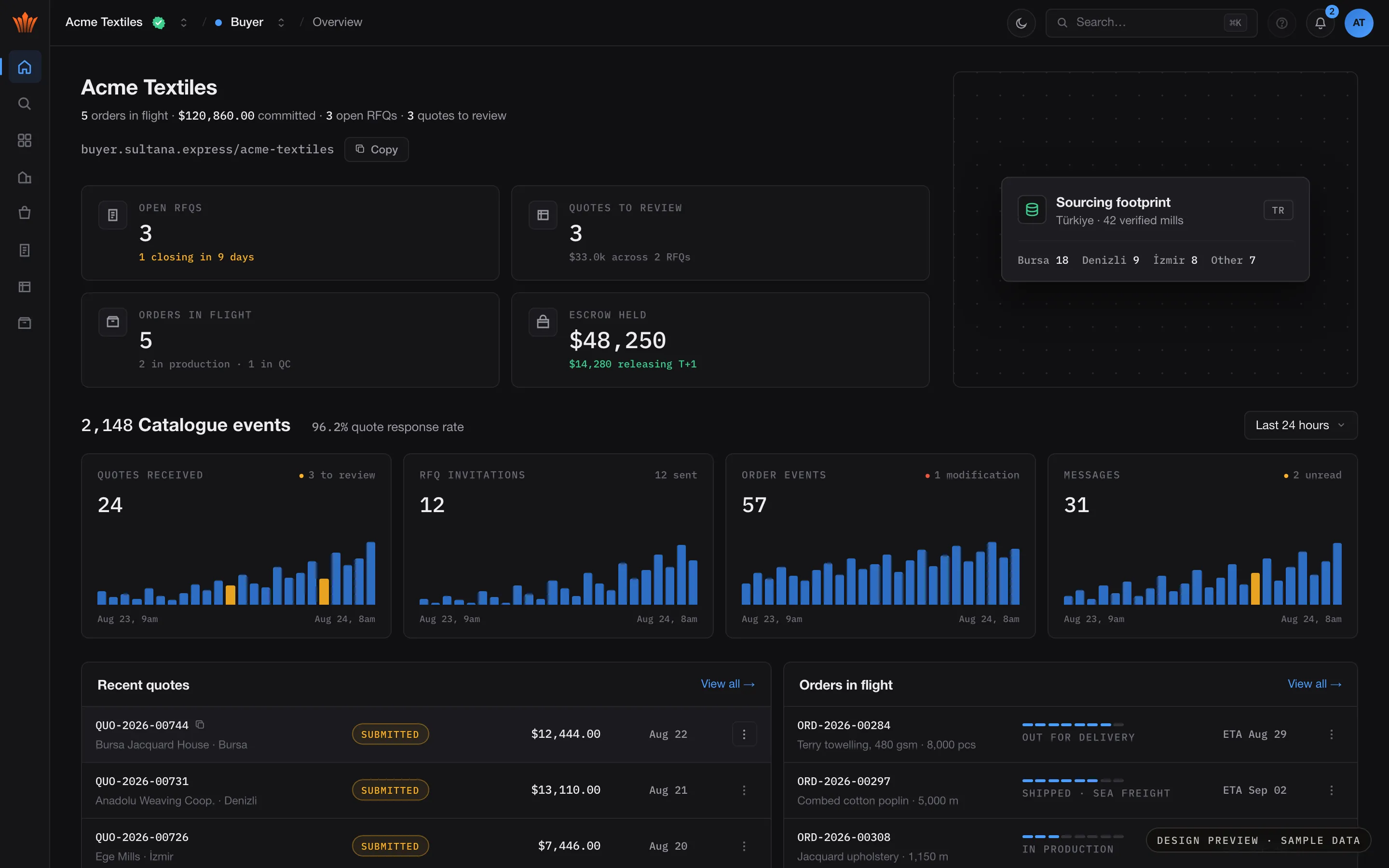
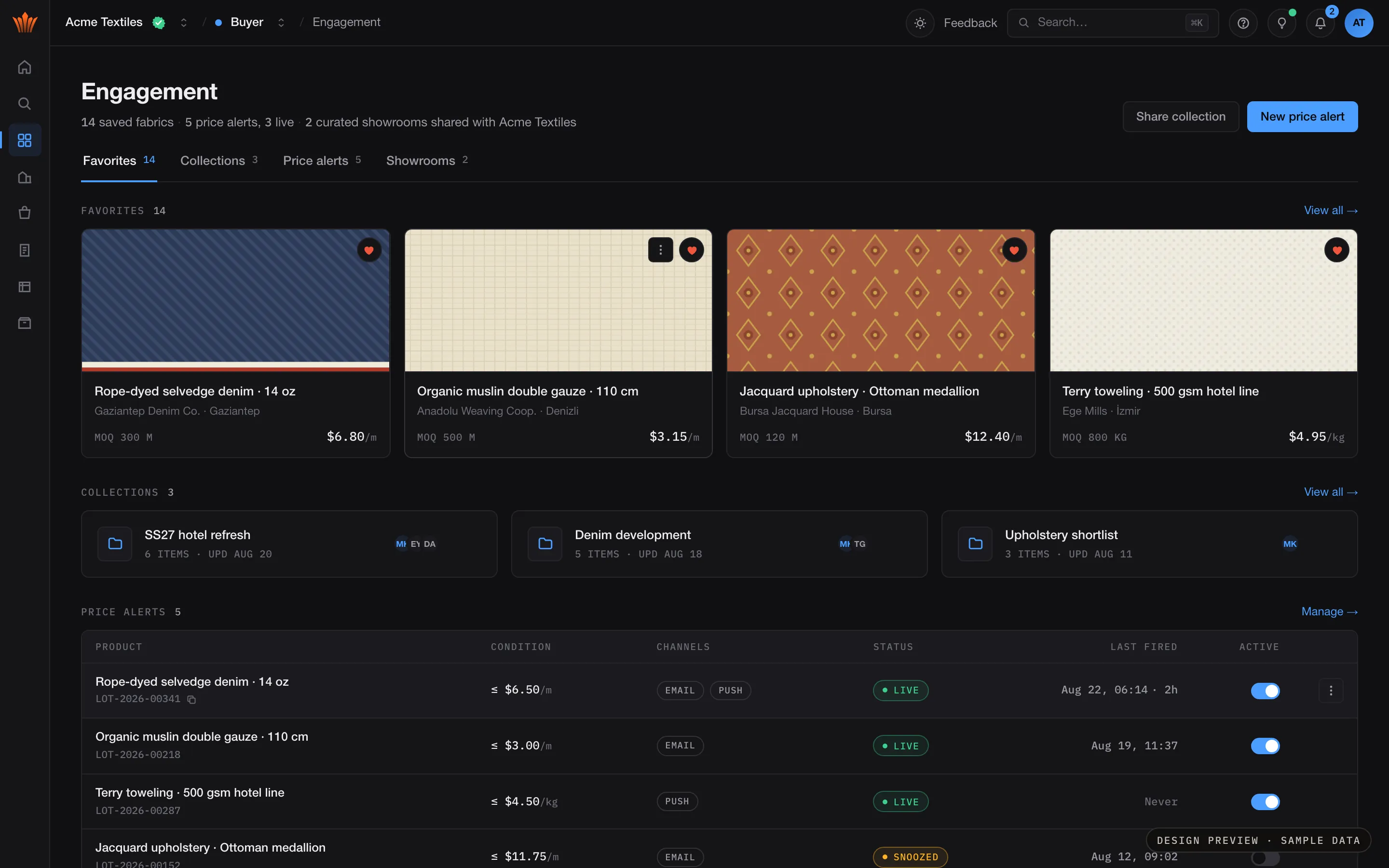
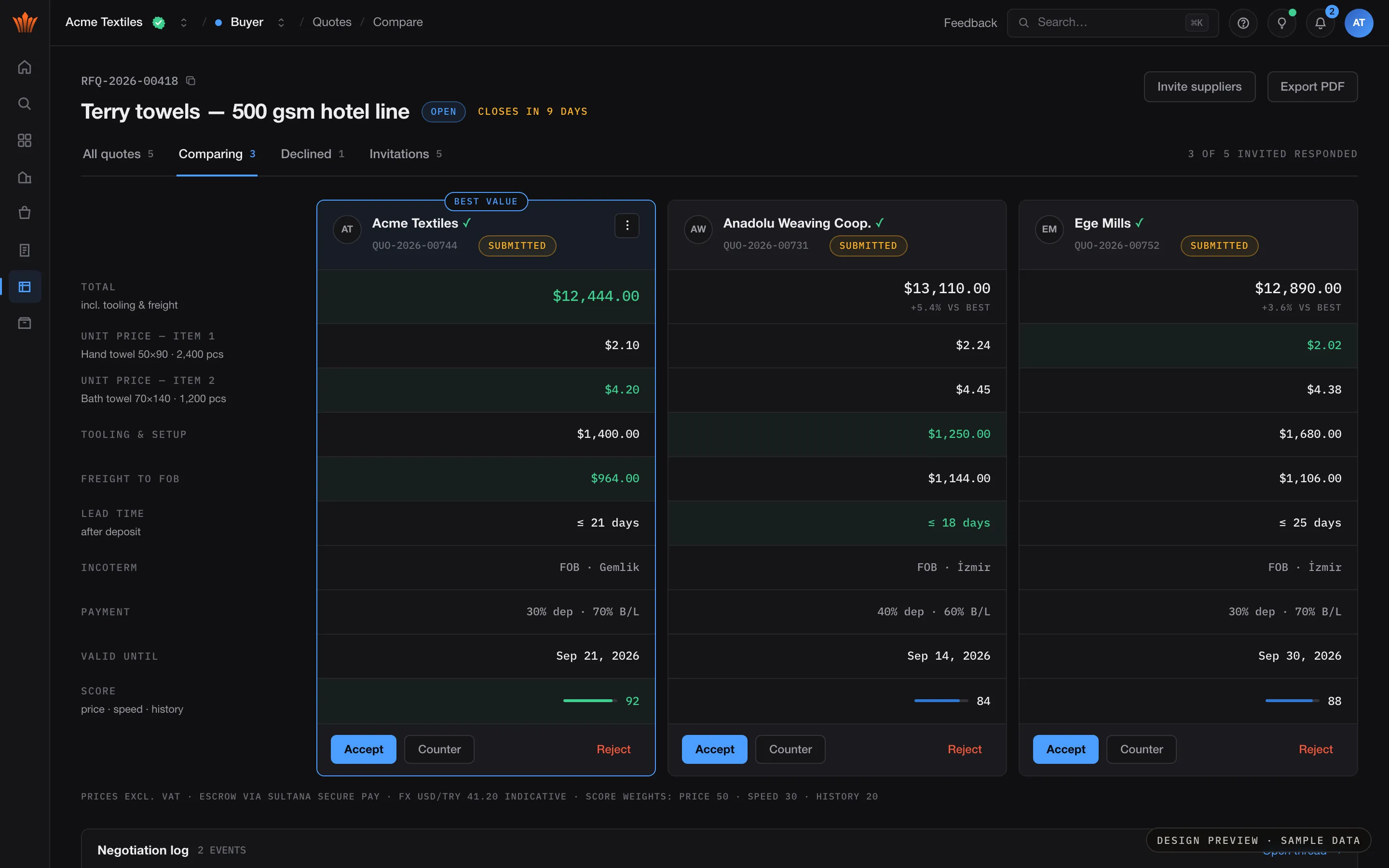
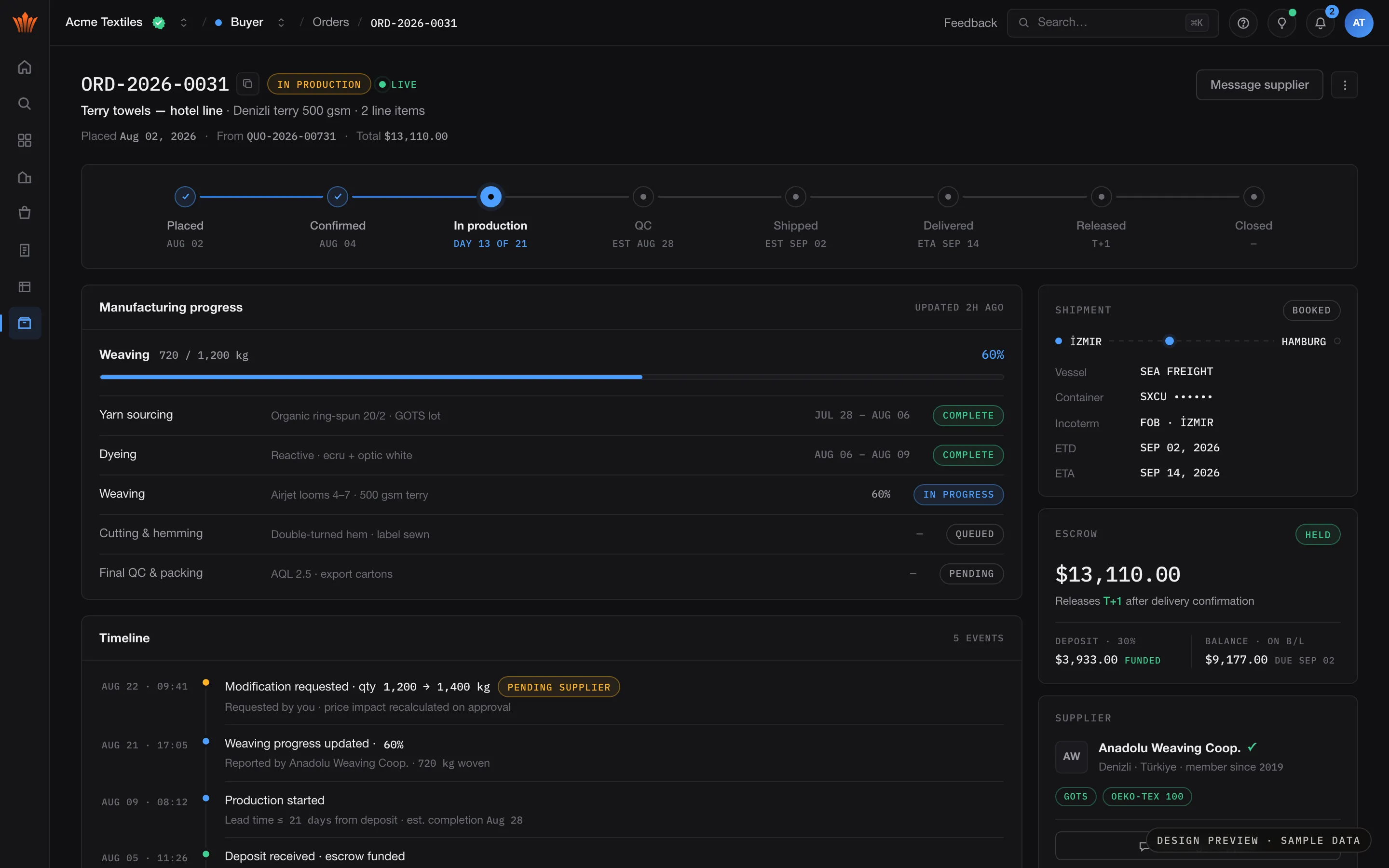
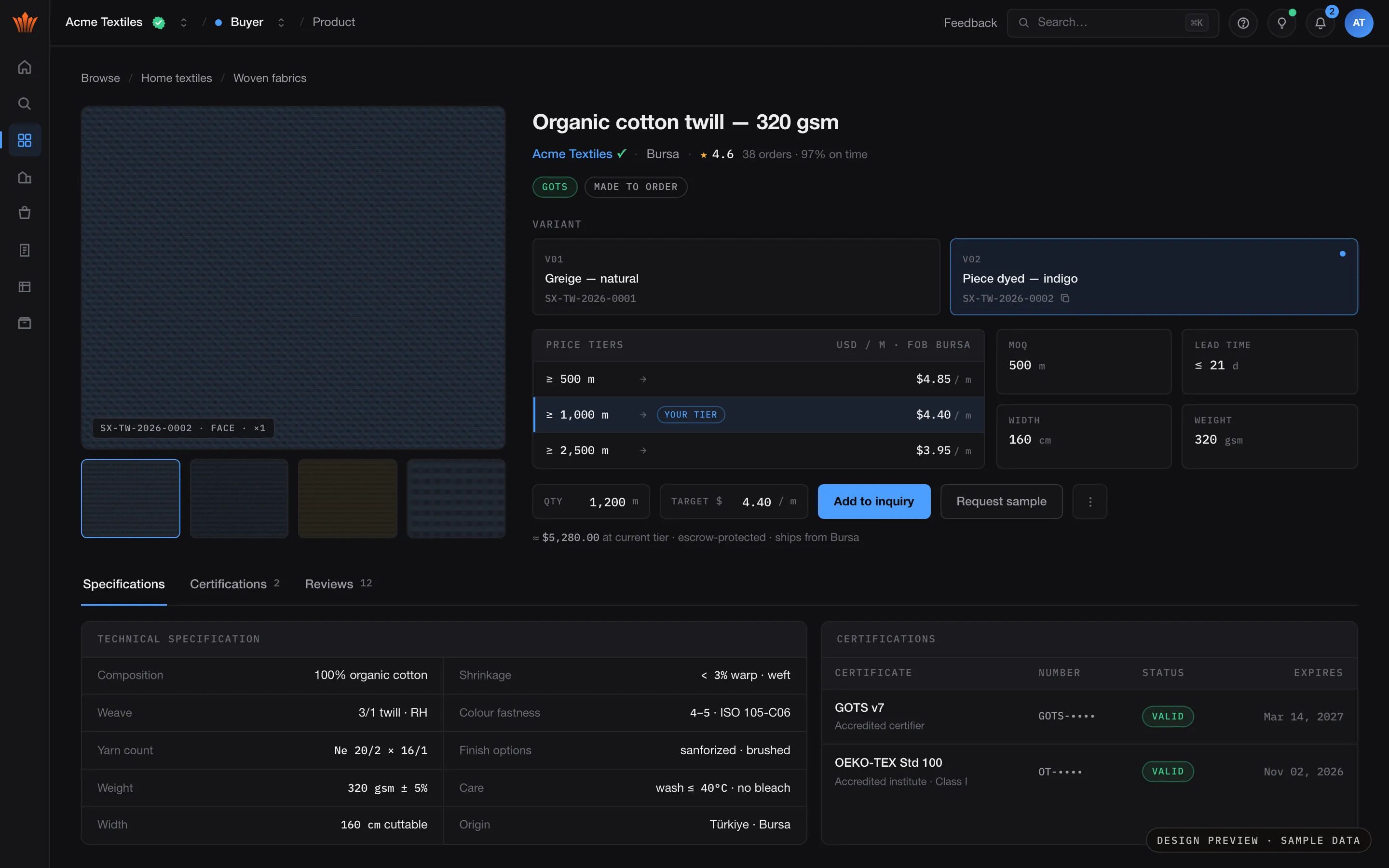
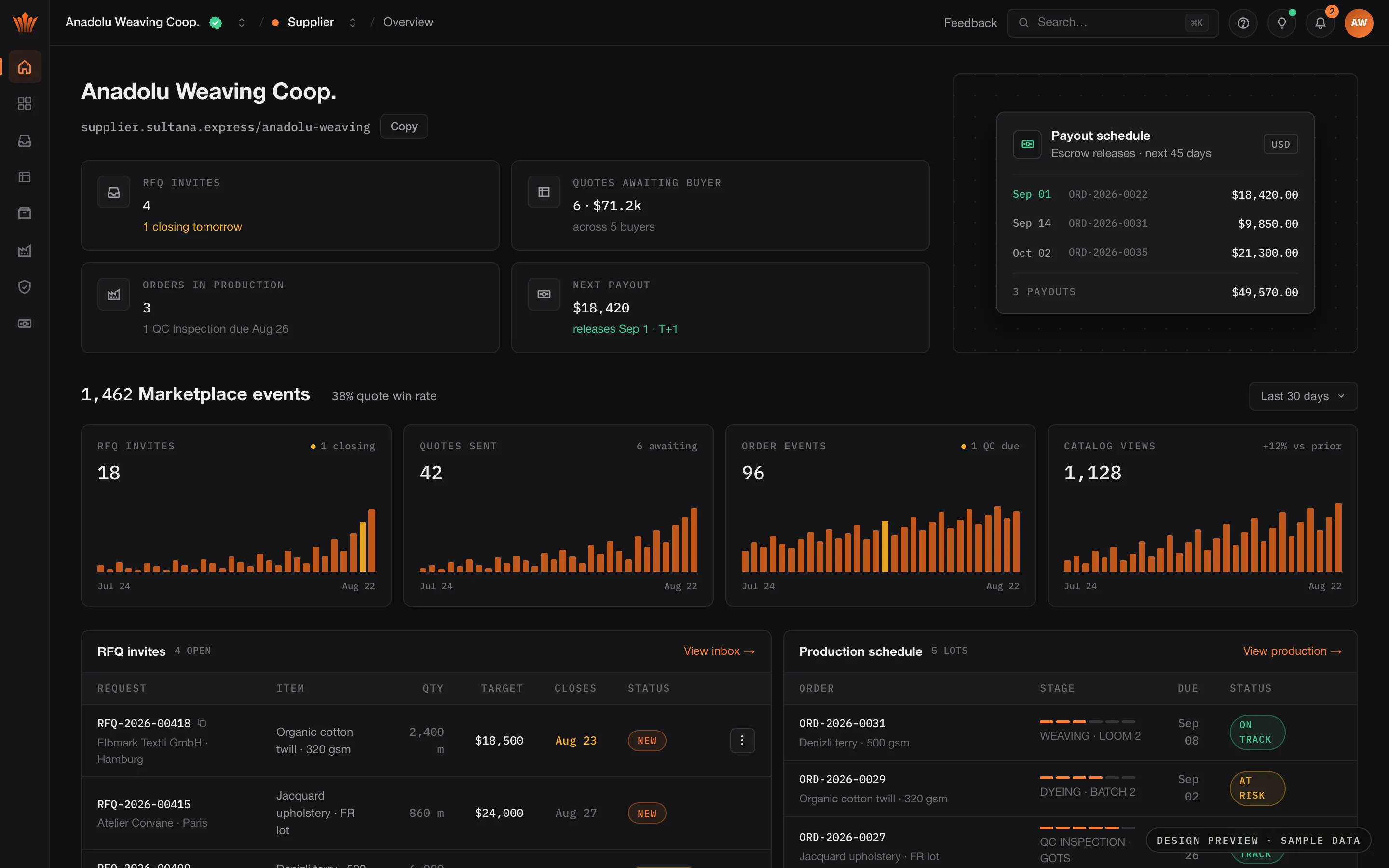
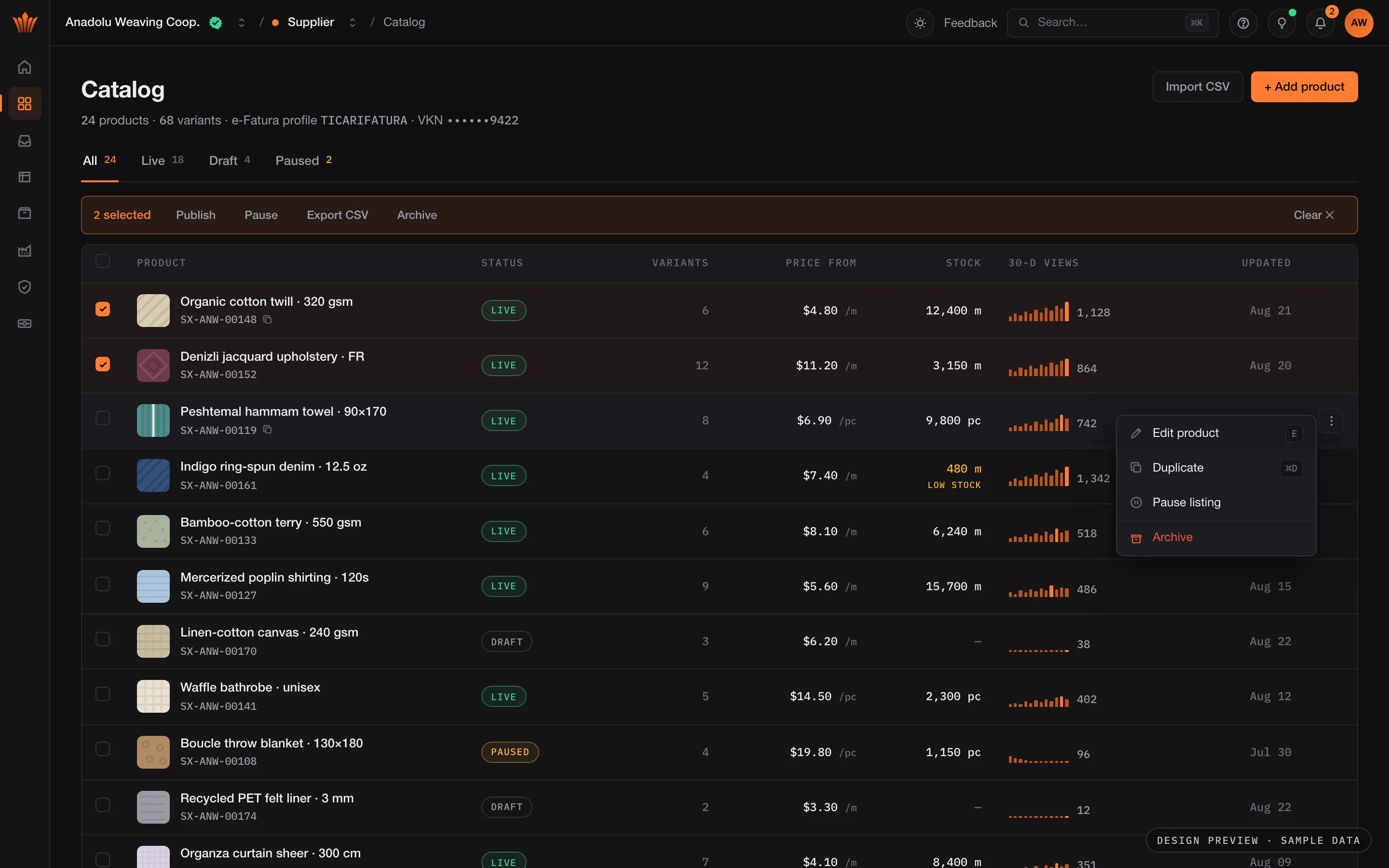
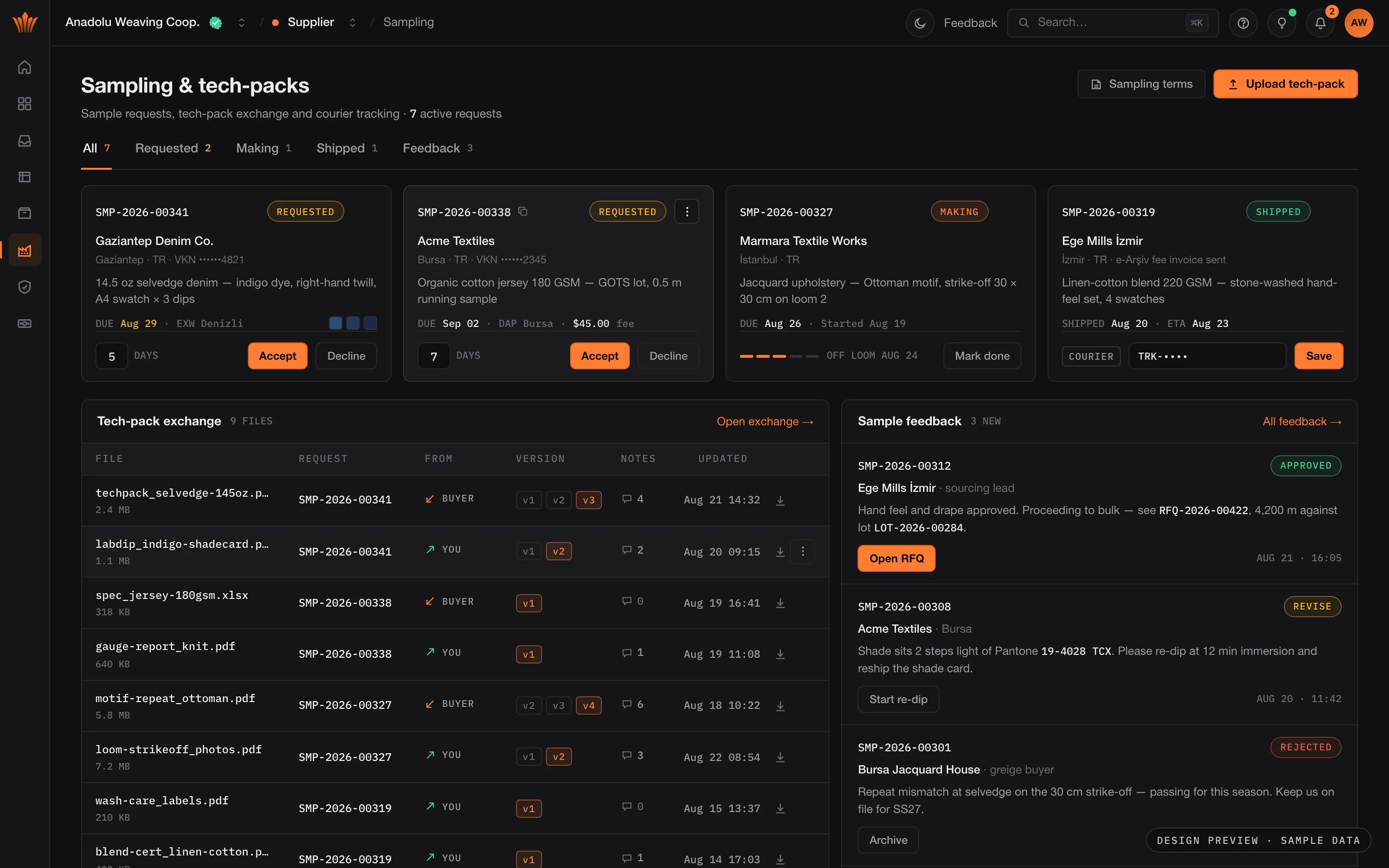
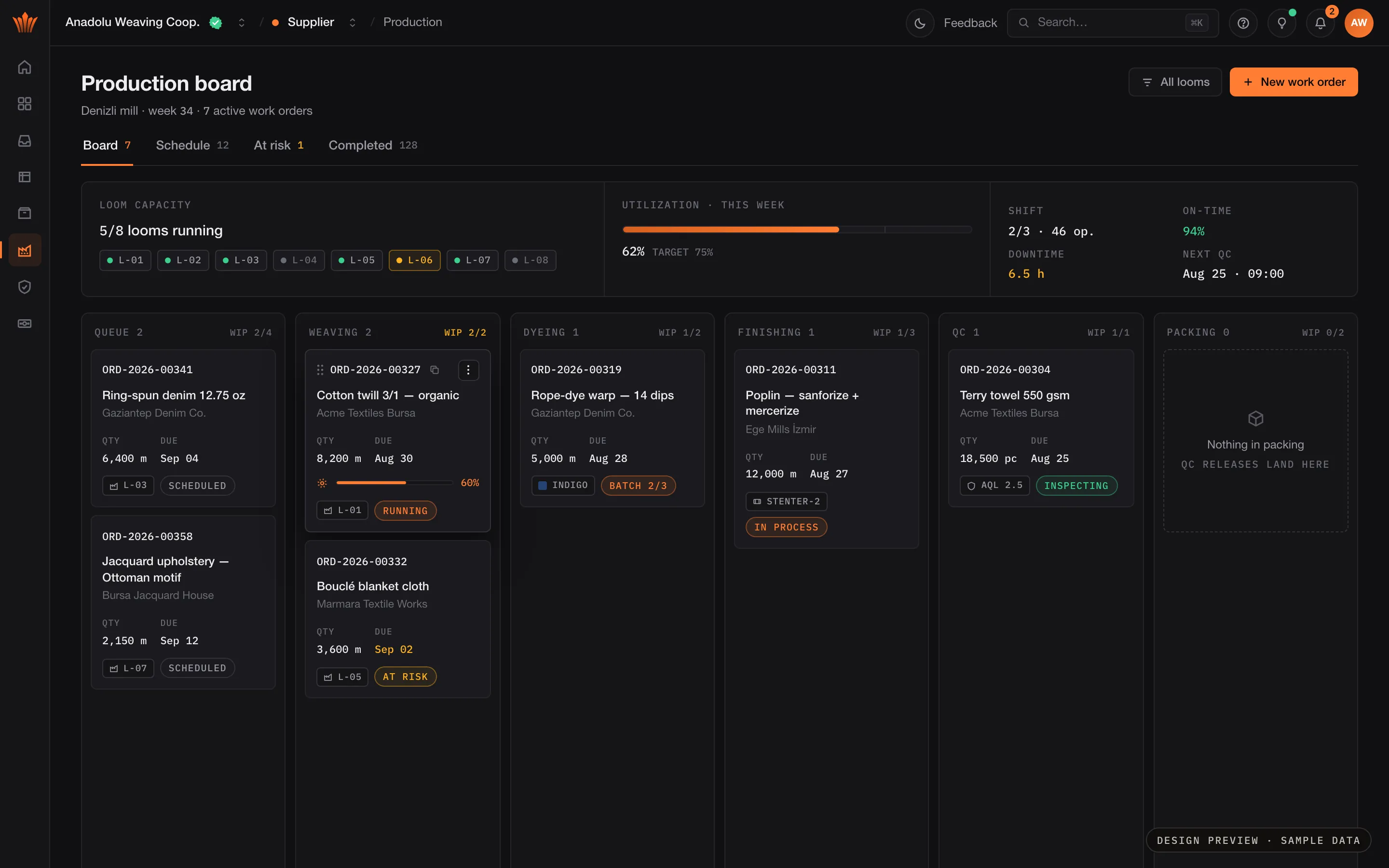
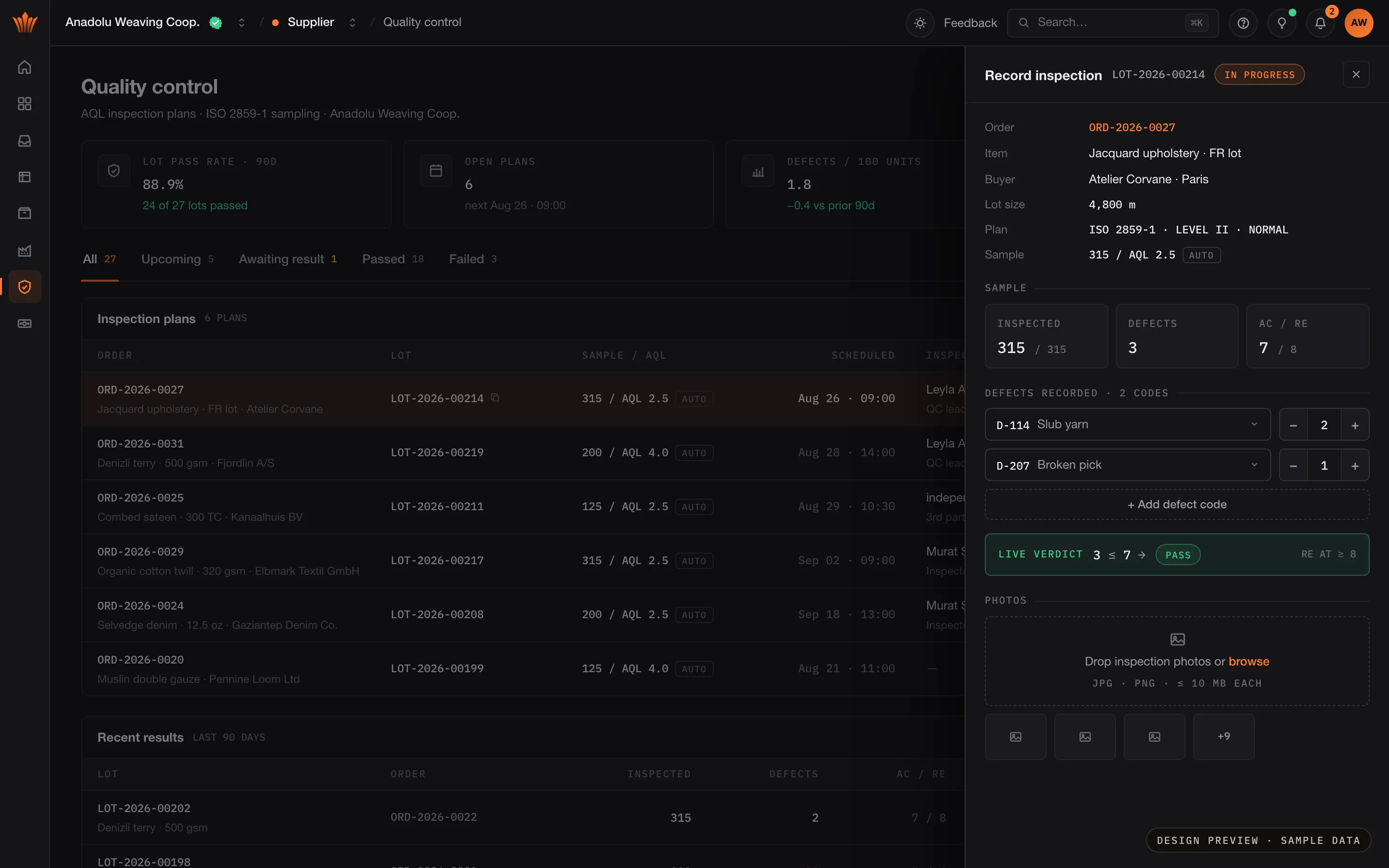
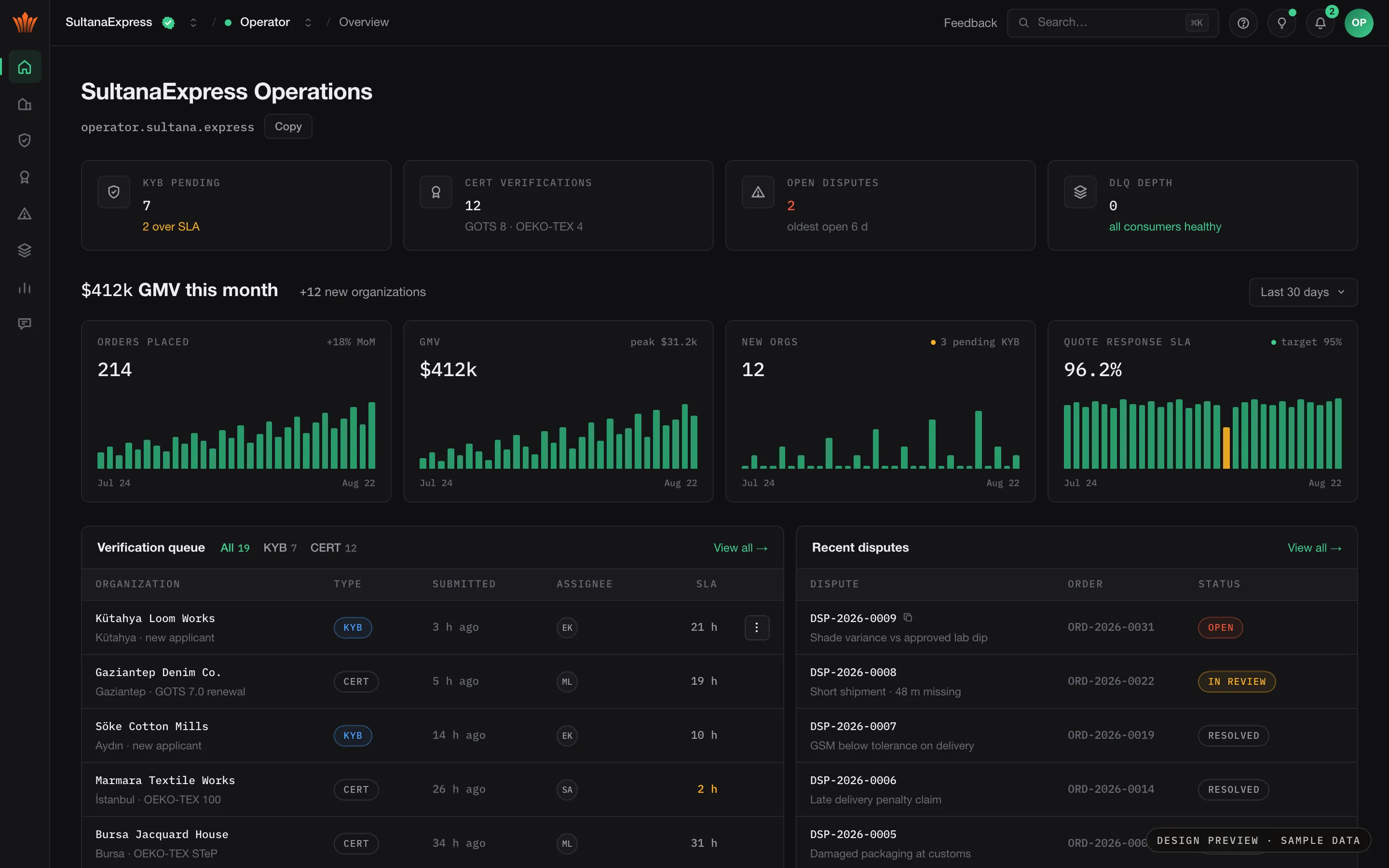
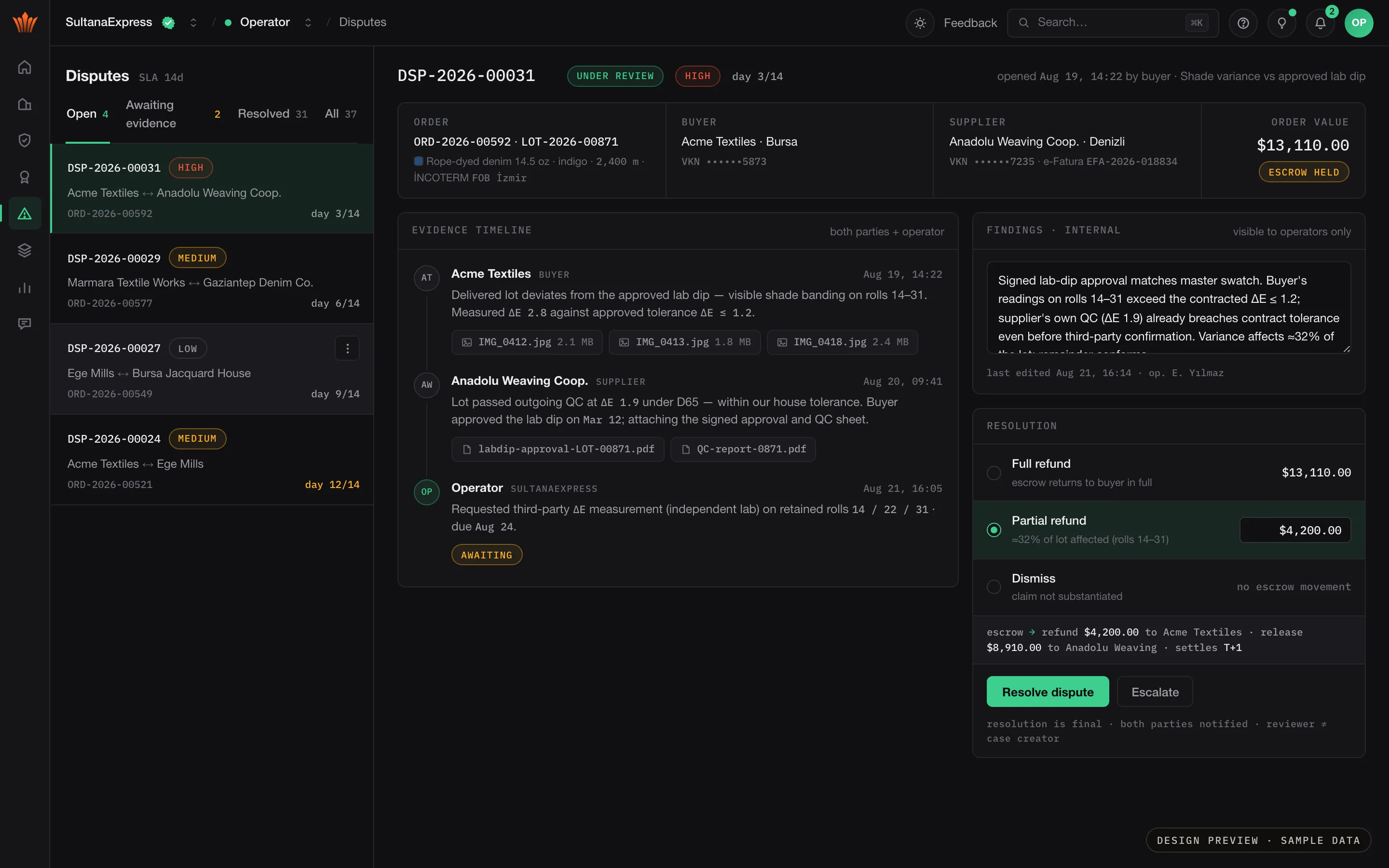
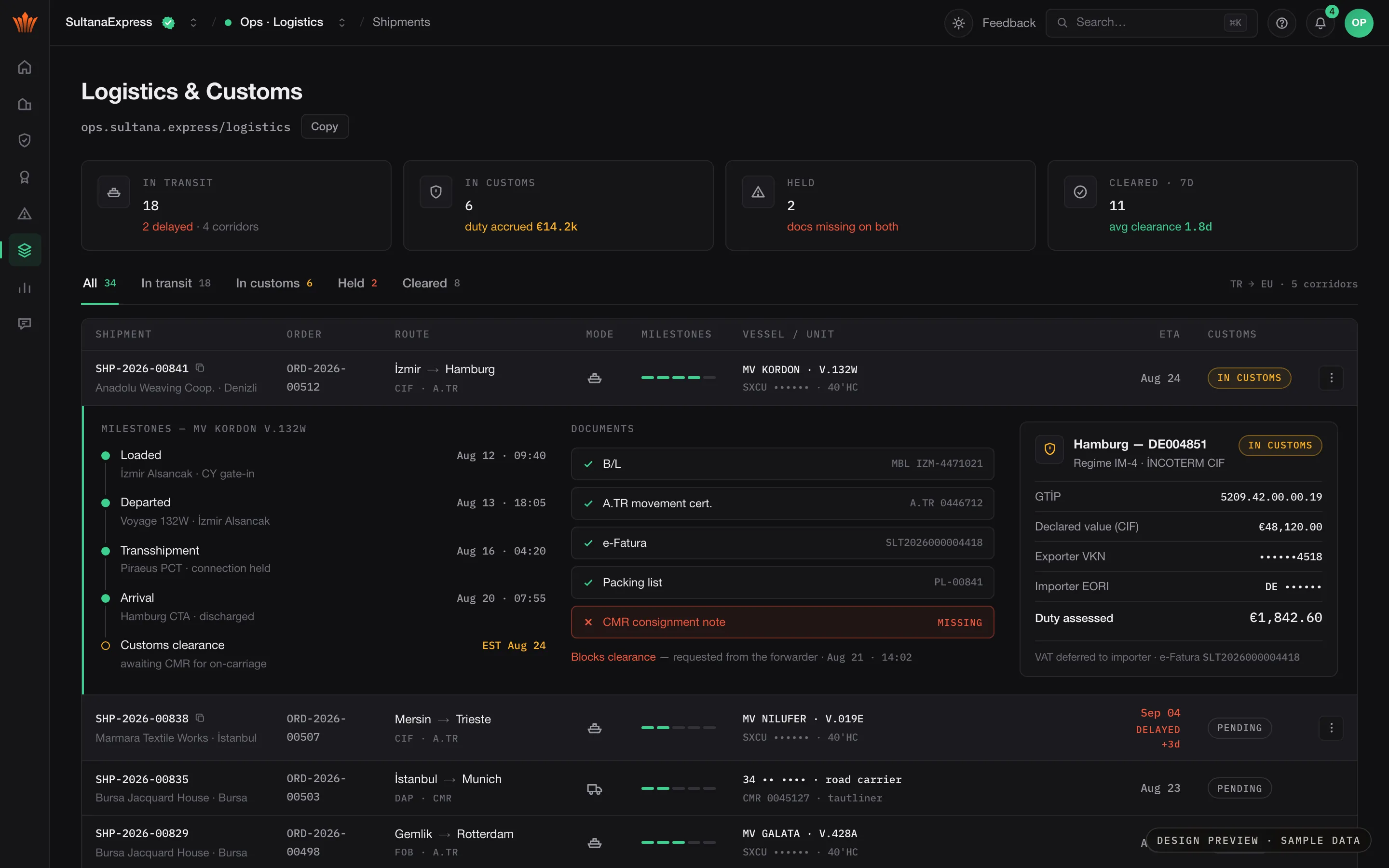
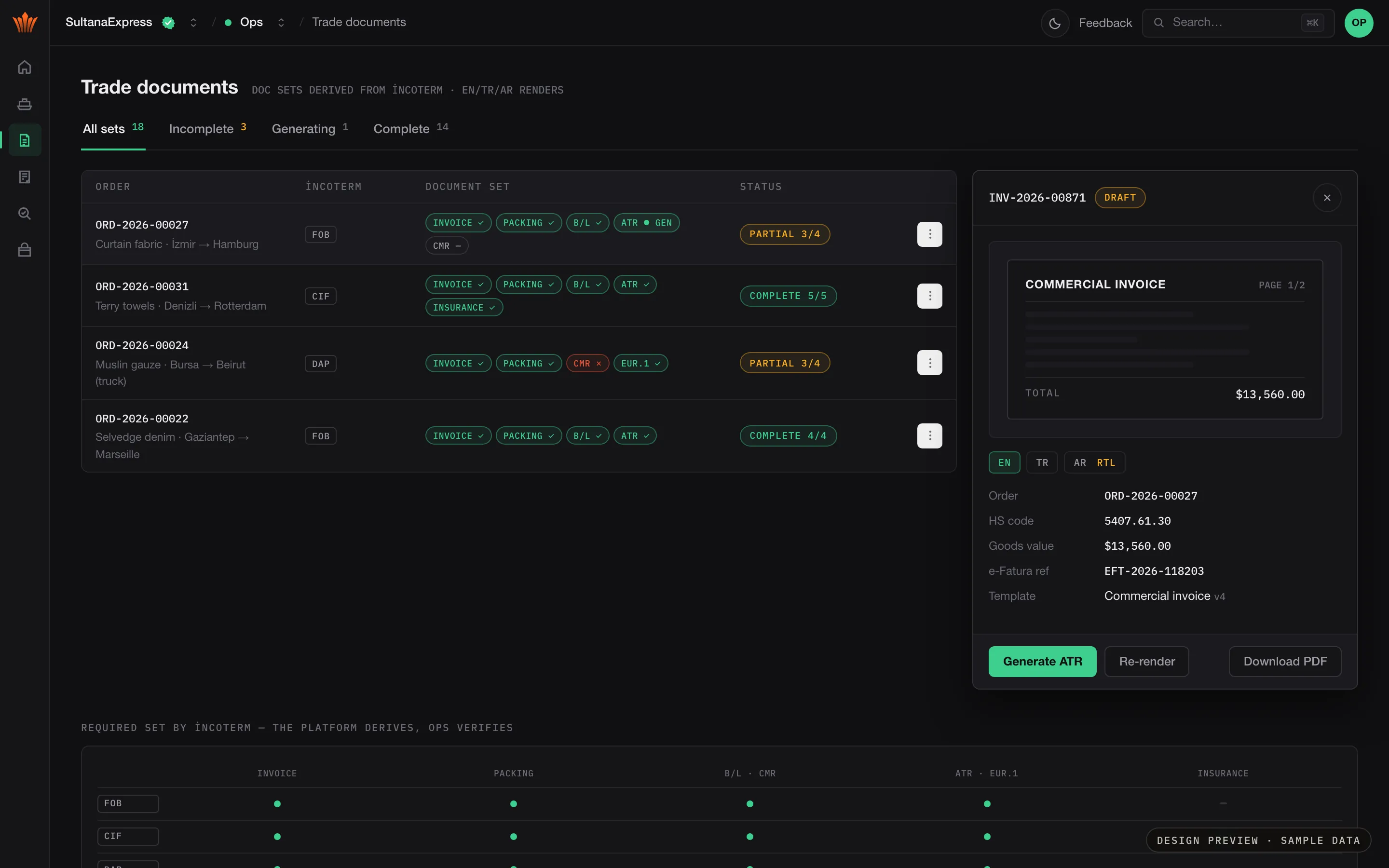
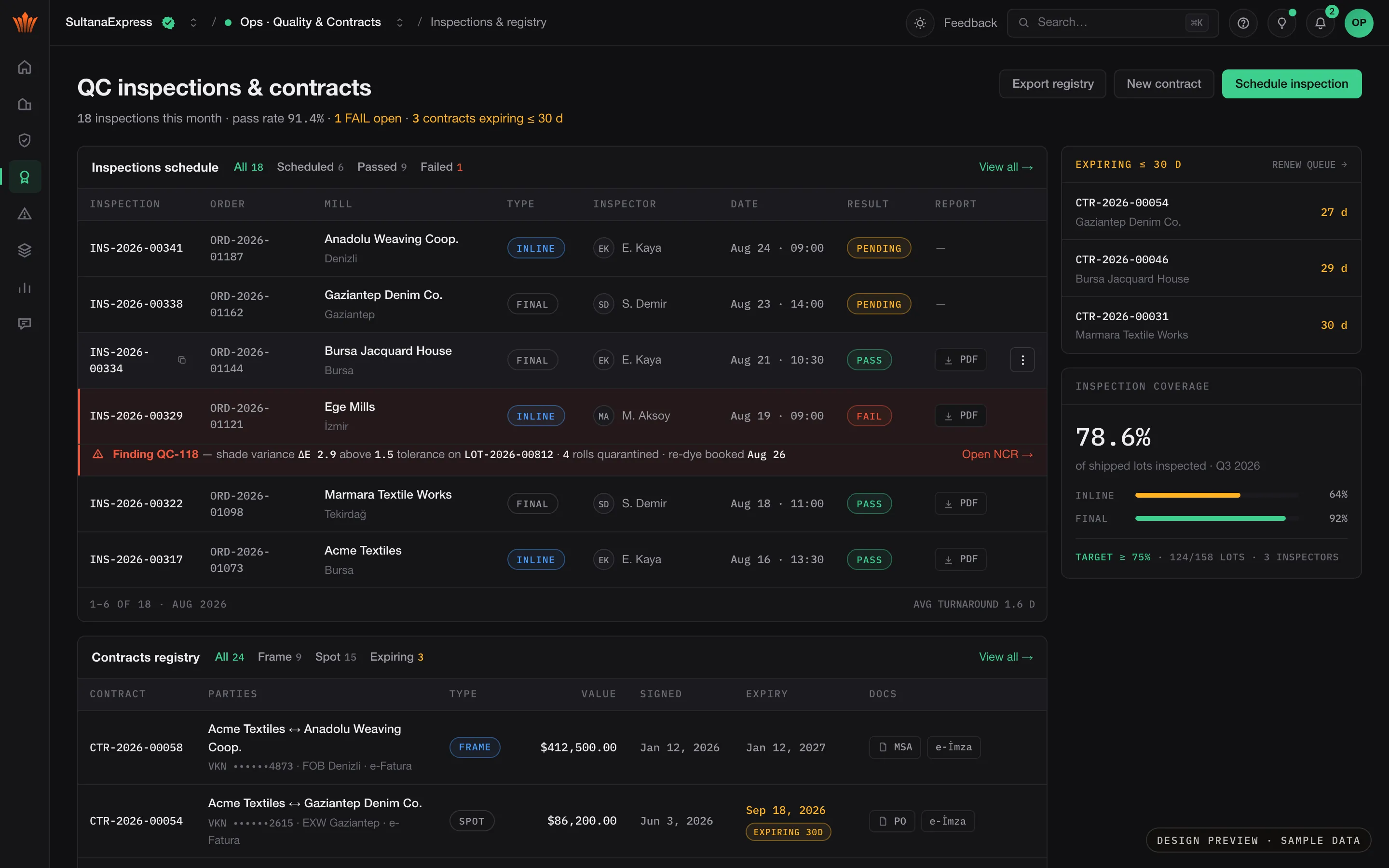
Design previews, not live screens. The redesign reaches the product app by app, after each app's screen-by-screen review. Company names, figures and dates are sample data.
Why Türkiye
Not a growth story — a structural one. Zero duty, road-freight distance, and an EU compliance clock that rewards documented supply chains.
- EU–Türkiye Customs Union: zero customs duties on industrial goods — including textiles and apparel. (European Commission)
- Türkiye's exports to the EU: $117B in 2025.
- The world's 7th-largest apparel exporter.
- Road freight Türkiye → EU: typically 3–7 days. Ocean China → Northern Europe: 58.2 days on average (Flexport, week to 27 Jul 2026).
The nearshoring is already happening: CBI names Inditex, H&M, Bestseller and Mango among the brands moving production to Türkiye.
The EU compliance clock
- 19 Jul 2026 — the ESPR ban on destroying unsold textiles is live.
- Textile EPR arrives in every EU member state within 30 months of 16 Oct 2025 (Waste Framework Directive).
- 14 Dec 2027 — the EU Forced Labour Regulation applies, to companies of every size.
Built in the open
Every phase closes behind a quality wall that plants real defects and refuses to pass until each one is rejected by name.
Four AI reviewers read every slice. None of them can merge code. The deterministic CI wall is the only authority — by construction.
Every number on this page traces to a file in the plan repo. When it changes, we change it here.
- 650 sub-phases planned · 500 done
- 73 merge-blocking CI checks across the stack
- 602 AI review passes · 3,833 findings by 2026-08-05 — all caught before merge, every code-actionable one fixed
- 4,430 approved reference screenshots — every UI change is compared against them
- A parallel design plan: every screen redesigned on a 106-element system — 12 of 28 steps done, not live yet
As of 2026-10-07. Counters are re-derived from the status board at every publish — never animated from zero, never invented.
Three people. One written plan.
We already built and ran this marketplace — a production iOS app on a Supabase backend. Then we audited our own system line by line — 106 tables, 341 stored procedures, 687 security policies, 228 catalogued features — and started over, properly.
Louis Loubes
CEO
Abdullah Kahvecioglu
CTO
Tatiana Loubes
CFO
The founding-supplier offer
3 months free at launch
When the platform launches, every system is free for every supplier for three months. Verification, catalog, RFQs and quotes, orders, documents — all of it.
The best founding suppliers win a year free
A prize program for the factories that build with us from day one. The headline prize: one year of free usage. Many will win. Further prizes to be announced — follow the build.
The honest FAQ
What exists today?
A complete supplier product — verification, catalog, variants and media, pricing, inventory, RFQs and quotes, orders, capacity, tech packs, sampling, production tracking, quality control, payouts — closed behind its own exit gate. The buyer application is complete too, from search through cart, checkout, order tracking, returns and tech-pack reviews, and so is the operator console. Behind all three, the engines of the chain — ledger, sample gate, capacity booking, AQL inspections — are built and proven by 73 merge-blocking CI checks. Now every screen is being redesigned on one new design system — not live yet.
What does "Beta — November 2026" mean?
First suppliers onboard in Turkey, our test market. Not a waitlist page — a working platform. Live card payments switch on at phase 150 of the plan, behind payment counsel, CPA and PSP sign-off. Those approvals block go-live by design — never the build.
When does Europe open?
After Turkey proves the loop. The Turkey→EU corridor — the zero-duty Customs Union, 3–7 day road freight — is the roadmap we are building toward, not a live service today.
What will it cost?
Free for buyers — that is a decision, not a promotion. For suppliers: everything free for the first three months after launch, and founding suppliers can win a year free. We publish pricing when there is pricing to publish — no invented tiers.
Get on the chain early.
Beta — November 2026. Turkey first, Europe next. Built in the open until then — and after.